
Inspired by Nature: Utilization of Owl Feathers as Reinforcement in Composite Materials
By Mufaddal Shakir
9/1/20253 min read
Introduction
Throughout history, nature has served as an engineer’s design handbook. From the lotus leaf inspiring self-cleaning coatings to the gecko’s feet guiding adhesive technologies, biomimicry has enabled breakthroughs across materials science. One of the most captivating natural examples comes from the owl feather.
Owls are renowned for their silent flight—a survival advantage that allows them to hunt without alerting prey. This stealth is not magic, but a direct consequence of the microstructural engineering of their feathers. These unique adaptations not only reduce noise but also optimize lightweight strength and aerodynamic efficiency. Such properties make owl feathers and their keratin-based composition a promising inspiration for green composites, noise-reducing structures, and sustainable materials.
In this article, we explore the theory, structure, processing, applications, and latest research surrounding owl feathers in the context of composite materials.
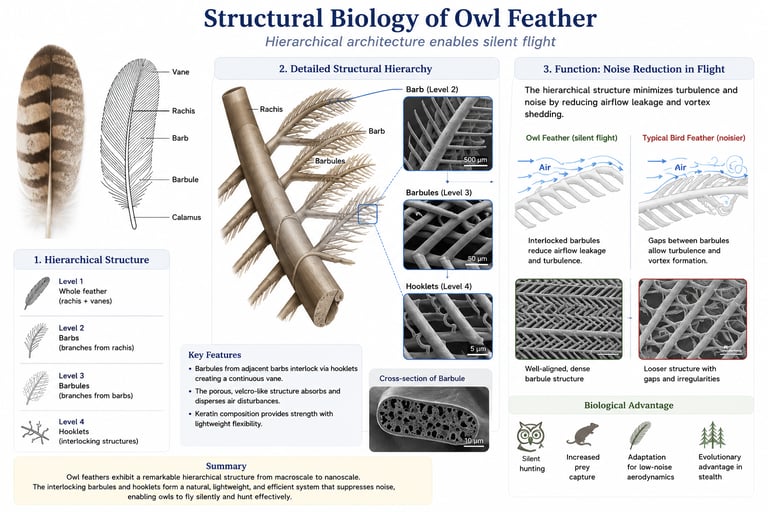
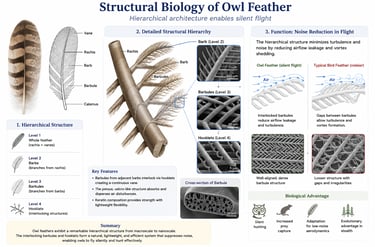
1) Structural Biology of Owl Feathers
Feathers are hierarchical, fiber-reinforced natural composites, mainly composed of β-keratin, a stiff and lightweight protein. Owl feathers differ from other birds due to three key microstructural adaptations:
a) Leading-edge serrations – Comb-like extensions on the primary wing feathers.
These break up large air vortices into smaller, less noisy eddies.
Function similar to leading-edge turbulators in modern aerodynamics.
b) Velvety dorsal surface – A dense covering of downy microstructures.
Reduces friction and dissipates sound energy.
Functions like a sound-damping carpet on the wing surface.
c) Flexible trailing edge fringes – Soft, porous extensions.
Reduce the abruptness of airflow separation.
Suppress broadband noise typically generated at trailing edges.
2) Composition and Material Properties
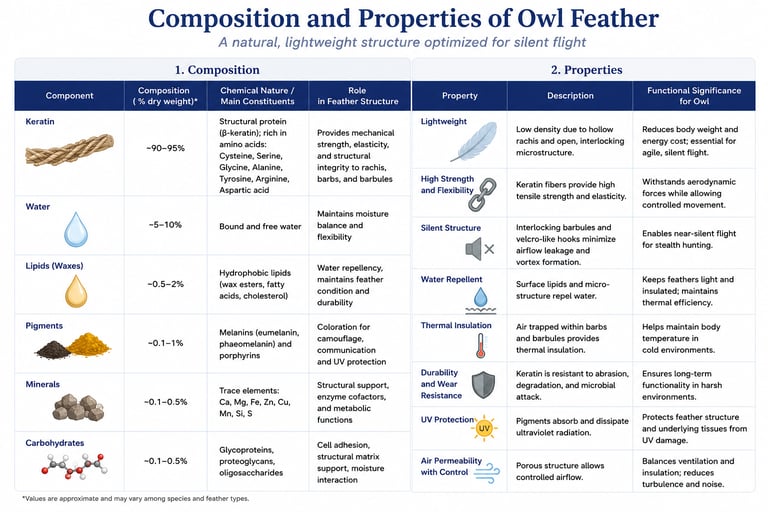
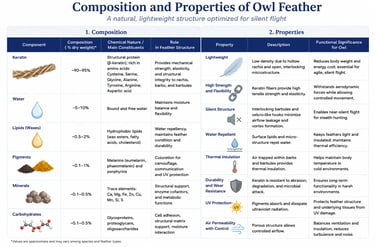
Owl feathers are primarily composed of β-keratin, which differs from mammalian α-keratin (hair, nails).
Key Features of β-keratin:
Semi-crystalline protein
Strong hydrogen bonding between polypeptide chains
Fibrous morphology with high aspect ratio
Naturally porous (lightweight, density ~0.9–1.3 g/cm³
While feathers cannot compete mechanically with advanced fibers like carbon or glass, their lightweight, damping, and sustainability advantages give them unique niches in composite applications.
3) Processing Owl Feathers into Composites
Turning feathers into usable composite reinforcements requires several steps:
a) Collection and Cleaning
Sterilization to remove oils, microbes, and impurities.
b) Mechanical Preparation
Cutting into short fibers, flakes, or powder depending on application.
c) Surface Treatment
Alkali or silane treatment improves fiber–matrix adhesion.
d) Composite Formation
Thermoplastics: feathers mixed into polypropylene (PP), polylactic acid (PLA), or PCL.
Thermosets: feathers reinforced in epoxies or phenolic resins.
Processing Techniques: compression molding, extrusion, injection molding.
4) Why Owl Feathers Matter for Composites?
Feathers are essentially natural fiber composites. The β-keratin fibrils serve as reinforcements, while the matrix is an amorphous keratin protein network.
Rule of Mixtures (ROM):
Predicts composite stiffness based on fiber volume fraction. Feather composites often fall below traditional ROM predictions due to weak interfacial bonding, but surface treatments improve this.Acoustic Theory:
Silent flight arises from disruption of turbulent boundary layers and broadband noise suppression. In composites, embedding feathers provides intrinsic damping, unlike stiff synthetic fibers.Fracture Mechanics:
Feather keratin exhibits fiber pull-out and crack deflection mechanisms, which improve toughness relative to brittle matrices.
5) Potential Applications
1. Aerospace & UAVs
Owl-inspired serrations are already applied to drone propellers and aircraft winglets for noise suppression.
Composites filled with feathers could be used for lightweight, noise-dampening panels in interiors.
2. Automotive
Feather composites can serve in non-structural panels, dashboards, and acoustic liners.
Potential replacement for petroleum-based foams and plastics.
3. Green Packaging
Biodegradable feather–PLA or feather–starch composites for sustainable packaging.
4. Construction
Soundproofing panels using feather composites to reduce indoor noise pollution.
6) Future Outlook
The real opportunity lies in biomimetic engineering:
Instead of using owl feathers directly, replicate their serrations, velvet textures, and fringes in 3D-printed or molded composites.
Develop keratin-derived resins or sizings to improve bonding in natural fiber composites.
Explore hybrid composites—e.g., glass fiber for strength + feather keratin for damping.
With sustainability becoming central to engineering design, owl feather–inspired composites could become vital in aerospace, automotive, and eco-materials industries.
Conclusion
Owl feathers represent a brilliant example of bioengineering by nature. Their structural hierarchy, acoustic control, and lightweight keratin composition inspire scientists to design next-generation composites. While direct utilization of owl feathers is impractical, their biological blueprint has already influenced quieter aircraft, better UAV propellers, and sustainable feather-based composites.
Nature has provided the design, now it is up to materials scientists to refine, replicate, and scale it for human applications.
Connect
Discover
Email: automaterials53@gmail.com
© 2026. AutoMaterialsInsights. All rights reserved.